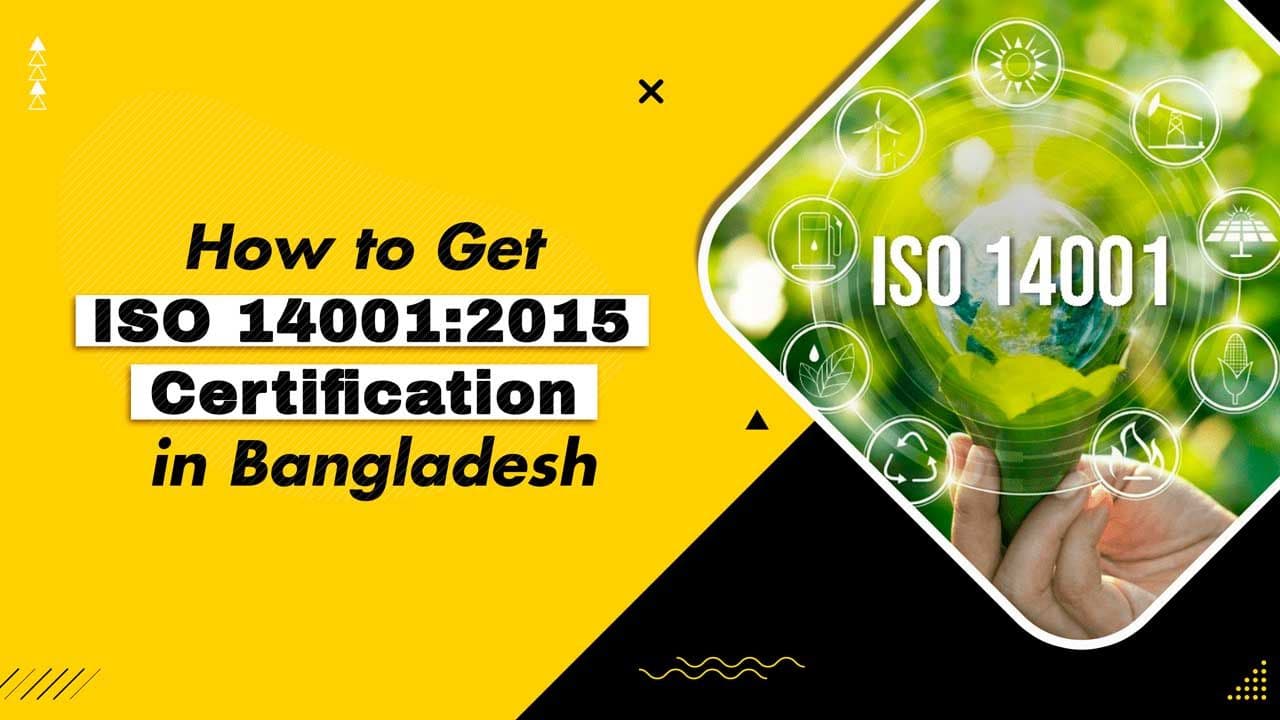
Why ISO 14001 Is More Urgent Than Ever for Bangladeshi Businesses
Get ISO 14001:2015 certification in Bangladesh with ease. Learn the steps, benefits, and costs of implementing an environmental management system.
Bangladesh's export-oriented industries face a new reality. Environmental compliance is no longer a choice, it is a market requirement.
The EU's Corporate Sustainability Reporting Directive (CSRD) and Carbon Border Adjustment Mechanism (CBAM) now require that companies supplying European buyers demonstrate measurable environmental management. Bangladesh, as the world's second-largest garment exporter with USD 38.48 billion in RMG export earnings in 2024, is directly in the path of these regulations. Major global brands including H&M and Zara are now actively requiring ISO 14001 or equivalent environmental credentials from their Bangladesh suppliers.
Beyond exports, the business case for ISO 14001 is well-evidenced. A peer-reviewed study analyzing South Korean manufacturing firms found that ISO 14001 adoption led to an average 34% reduction in carbon emissions. Research published in the journal Energy Efficiency found that ISO 14001 adoption is linked to lower energy intensity, reduced greenhouse gas emissions, and greater use of renewable energy across manufacturing companies. According to ILO data cited by HMS Universal, ISO 14001 certification can reduce water consumption in textile dyeing operations by up to 25%, while also cutting operational costs in certified facilities by up to 20%.
For Bangladeshi businesses in garments, manufacturing, food processing, or any sector with a significant environmental footprint, ISO 14001 certification is now one of the most practical investments available.
What Is ISO 14001:2015?
ISO 14001:2015 is the international standard for Environmental Management Systems (EMS). It is published by the International Organization for Standardization. The current version was released in 2015 and replaced the earlier ISO 14001:2004 edition. It is the only standard in the ISO 14000 family that organizations can be certified against.
The standard gives any organization, regardless of size, sector, or location, a structured framework to identify, manage, monitor, and continuously improve its environmental impacts. It is built on the Plan-Do-Check-Act (PDCA) cycle and the Annex SL High Level Structure, which means it integrates smoothly with ISO 9001 (Quality) and ISO 45001 (Safety) if you already hold or are pursuing those certifications.
ISO 14001 does not tell you what specific targets to hit. Instead, it requires your organization to set its own environmental objectives, measure progress, and demonstrate continuous improvement over time.
Key outcomes ISO 14001 delivers:
A formal environmental policy with leadership commitment
A legal register that tracks all environmental obligations your business must meet
Identification and control of significant environmental aspects such as water use, emissions, energy consumption, and waste
A monitoring and measurement system to track your environmental performance
A culture of continuous improvement in how your business interacts with the environment
Who Needs ISO 14001 Certification in Bangladesh?
ISO 14001 applies to any organization that wants to manage its environmental impact. In Bangladesh, the sectors with the most to gain are:
Garments and textiles
Bangladesh has over 230 LEED-certified green garment factories, more than anywhere else in the world. ISO 14001 is the management system standard that sits behind many of these environmental credentials. EU buyers and global fashion brands now include ISO 14001 in their supplier requirements. See our full guide to sustainability and compliance for Bangladeshi businesses.
Manufacturing and export units
Any factory that handles chemicals, generates waste, consumes significant energy, or discharges effluent needs a structured EMS to manage these impacts and stay compliant with the Bangladesh Department of Environment (DoE) regulations.
Food and beverage processing
Food processing companies deal with water use, organic waste, packaging, and chemical inputs. ISO 14001 provides the framework to manage these systematically and meet the environmental expectations of international food buyers. Consider pairing with ISO 22000 food safety certification.
Construction and real estate
Building projects generate significant waste, use large quantities of water and materials, and have a measurable impact on surrounding environments. ISO 14001 helps construction companies document and manage these impacts professionally.
IT and industrial services
ISO 14001 is increasingly adopted by IT companies, particularly those serving EU clients, as it demonstrates environmental responsibility in operations including data centers, office energy use, and electronic waste. See our guide for IT companies pursuing ISO certification.
Pharmaceutical and chemical companies
These sectors handle hazardous substances and are subject to strict environmental regulations. ISO 14001 helps them maintain compliance and demonstrate accountability to regulators and buyers.
Business Benefits of ISO 14001 Certification
Market Access and Export Requirements
ISO 14001 is now explicitly required or strongly preferred by EU buyers under the new CSRD framework. Companies certified to ISO 14001 can systematically plan and implement climate protection measures, which directly supports the environmental reporting requirements that EU buyers must pass down their supply chains. Without it, Bangladeshi exporters face growing risk of losing contracts to certified competitors.
Operational Cost Reduction
The EMS framework forces organizations to look closely at how they use energy, water, and raw materials. ISO-certified facilities reduce operational costs by up to 20% by optimizing processes and reducing waste. This is not a one-time gain but a compounding improvement as the system matures each year.
Regulatory Compliance
The Bangladesh Department of Environment (DoE) enforces environmental regulations including the Environment Conservation Act and environmental discharge standards. ISO 14001 requires your organization to maintain a legal register of all applicable environmental regulations and demonstrate compliance during every audit. This significantly reduces the risk of regulatory penalties.
Stakeholder and Investor Confidence
Certification demonstrates to customers, investors, government agencies, and local communities that your organization manages its environmental impact responsibly. This is increasingly important as ESG (Environmental, Social, Governance) reporting becomes a standard part of doing business with international partners.
Compatibility with Other ISO Standards
Because ISO 14001:2015 shares the Annex SL High Level Structure with ISO 9001:2015 and ISO 45001:2018, organizations that already hold one of these certifications can integrate ISO 14001 with minimal duplication of documentation and audits. An Integrated Management System covering quality, environment, and safety is one of the most efficient ways to meet multiple buyer requirements at once.
Step-by-Step Guide to Getting ISO 14001 Certified in Bangladesh
Step 1: Understand the Standard Requirements
Before starting the process, make sure your leadership team understands what ISO 14001 requires. The standard has 10 clauses (Clauses 1 to 3 are introductory; Clauses 4 to 10 contain requirements):
Clause 4: Understand your organization's context, including who your stakeholders are and what environmental regulations apply to you.
Clause 5: Top management must create an environmental policy and take visible leadership responsibility for the EMS.
Clause 6: Identify your environmental aspects, assess their significance, list legal obligations, and set measurable environmental objectives.
Clause 7: Provide resources, training, and documented information to support the EMS.
Clause 8: Implement operational controls for your significant environmental aspects, including emergency preparedness procedures.
Clause 9: Monitor and measure your environmental performance, conduct internal audits, and hold management reviews.
Clause 10: Address nonconformities, implement corrective actions, and continuously improve the EMS.
Step 2: Choose an Accredited Certification Body
Select a certification body that holds valid accreditation from the International Accreditation Forum (IAF). IAF accreditation is the only way to guarantee that your certificate is internationally recognized by EU buyers, government tenders, and global supply chains.
Look for bodies accredited through UKAS (United Kingdom), IAS (USA), or JAS-ANZ (Australia and New Zealand). Learn more about Youable's accreditation and the globally recognized registrars we work with.
The certification body will review your scope, provide a cost proposal, and agree on a timeline.
Step 3: Conduct an Environmental Gap Analysis (Stage 1 Audit)
The certification body performs a Stage 1 audit, also called a gap analysis. This compares your current practices against ISO 14001 requirements. The review covers:
Existing environmental policies and documentation
Compliance with Bangladesh environmental laws and regulations
How your organization currently identifies and controls its environmental aspects
Current monitoring systems and records
The gap analysis produces a report showing exactly what needs to be built or improved before you can pass the certification audit.
Step 4: Develop and Implement Your EMS
Based on the gap analysis, you build or strengthen your Environmental Management System. For most organizations, this involves:
Writing an environmental policy signed by top management
Completing an environmental aspects and impacts register (identifying how your activities, products, and services interact with the environment)
Building a legal register of all environmental laws and regulations that apply to you
Setting measurable environmental objectives with targets and timelines
Documenting key operational controls and emergency response procedures
Training all staff with environmental responsibilities
This phase typically takes 3 to 6 months depending on the complexity of your operations and how much existing documentation you already have.
Step 5: Conduct an Internal Audit
Before the certification audit, you run an internal audit to check whether the EMS you have built actually works and complies with the standard. The internal audit should be carried out by someone who was not directly involved in building the system.
The internal audit often reveals a few remaining gaps or nonconformities that can be fixed before the external auditor arrives. Doing this properly is one of the most effective ways to avoid failing the certification audit.
Step 6: Hold a Management Review
Before the Stage 2 audit, top management must hold a formal management review meeting to assess the performance of the EMS. This meeting evaluates internal audit results, the status of environmental objectives, any incidents or nonconformities, and upcoming risks and opportunities. The outputs feed into the corrective actions and improvement plans that the auditor will check.
Step 7: Certification Audit (Stage 2 Audit)
The certification body conducts a comprehensive audit to verify that your EMS meets ISO 14001:2015 requirements. The auditor will:
Review all EMS documentation, policies, and records
Interview staff at multiple levels, including operational workers and management
Inspect how environmental controls are actually applied in practice
Check that monitoring and measurement systems are working
Any nonconformities identified must be addressed and evidence submitted. A technical committee then reviews the audit results and approves the certificate.
Step 8: Receive Your ISO 14001 Certificate
Once approved, the certification body issues your ISO 14001:2015 certificate. The certificate shows the certification scope, the standard version, and the issue and expiry dates. It is valid for three years, with annual surveillance audits in years one and two.
For recertification guidance, read our guide: ISO 9001:2015 renewal in Bangladesh (the recertification process follows the same structure for ISO 14001).
How Long Does ISO 14001 Certification Take?
Organization Type
Typical Timeline
Small business (under 50 employees)
3 to 5 months
Medium-sized manufacturer
5 to 7 months
Large enterprise or complex operations
7 to 10 months
Integrated with ISO 9001 or ISO 45001
Add 1 to 2 months
These timelines assume that implementation work starts promptly after the gap analysis. Organizations with already documented processes move faster.
How Much Does ISO 14001 Certification Cost in Bangladesh?
The total cost typically falls within these ranges:
Organization Size
Typical Cost Range
Small businesses
BDT 100,000 to BDT 250,000
Medium to large enterprises
BDT 250,000 to BDT 600,000 or more
Main cost components:
Environmental consultancy and implementation support
Gap analysis (Stage 1 audit) fee
Staff training on ISO 14001 requirements
Documentation development and EMS setup
Stage 2 certification audit fee
Annual surveillance audit fees in years one and two
The long-term return is well documented. ISO-certified facilities reduce operational costs by up to 20% through better resource management. For export-focused businesses, the ability to qualify for international contracts that require environmental certification typically recovers the investment within the first year.
For a personalized cost estimate, contact Youable for a free consultation.
ISO 14001 and the EU CSRD: What Bangladesh Exporters Need to Know
This is a major content gap that most ISO 14001 guides in Bangladesh do not cover.
The EU's Corporate Sustainability Reporting Directive (CSRD), which came into full force in 2024 to 2025, requires large EU companies to report on the environmental performance of their entire supply chain. This means that EU buyers must now verify that their Bangladesh suppliers are managing environmental impacts. ISO 14001 is the internationally recognized framework that satisfies this requirement.
Additionally, the EU Carbon Border Adjustment Mechanism (CBAM) places carbon costs on imported goods from outside the EU. While CBAM currently applies to specific sectors, its scope is expanding. Bangladesh manufacturers with ISO 14001 already have the carbon monitoring and management systems in place to respond as CBAM requirements evolve.
For Bangladeshi exporters, getting ISO 14001 certified now is not just about the immediate benefits. It is also about being prepared for the compliance requirements that EU buyers will escalate over the next three to five years.
Common Mistakes to Avoid
Ignoring legal requirements: Your EMS must include a legal register that identifies every environmental regulation applying to your business. Missing this during the audit is a major nonconformity.
Poor documentation: ISO 14001 requires documented information to be maintained and controlled. Incomplete or outdated records are one of the most common audit failures.
Insufficient staff training: Your environmental controls only work if the people carrying them out know what they are doing and why. Train your team before the audit, not during it.
Choosing an unaccredited certification body: Always verify IAF accreditation before signing any agreement. An unaccredited certificate will not be accepted by international buyers or government tenders.
Treating the EMS as a paper exercise: The auditor will check whether your environmental controls are actually applied in practice, not just documented on paper. Your staff need to be able to explain the system and demonstrate it during the audit.
Tips for a Smooth Certification Process
Appoint a dedicated EMS coordinator. One person should own the project from start to finish. This does not need to be a full-time role, but it must be a named responsibility.
Involve all departments early. ISO 14001 affects operations, procurement, maintenance, HR, and management. Cross-functional involvement improves the quality of the EMS and reduces gaps.
Build the legal register before anything else. Knowing exactly which environmental laws apply to you determines the shape of your entire EMS.
Track environmental performance from day one. Start measuring your energy use, water consumption, and waste generation as soon as the EMS is drafted. This data will be reviewed during the certification audit.
Consider pairing with ISO 50001. If your operations have high energy costs, combining ISO 14001 with ISO 50001 energy management maximizes both environmental and cost benefits. The two standards are highly complementary.
Which Standards Complement ISO 14001?
If you also need...
Pair with...
Quality management
Worker health and safety
Energy cost reduction
Food safety management
Textile sustainability credentials
Recycled material claims
All three management standards
Integrated Management System (IMS)
For more detailed information on certifications by sector, visit our all-industries certification guide.
Frequently Asked Questions
What is ISO 14001:2015 used for?
It certifies that your business has a structured Environmental Management System in place to identify, manage, and reduce its environmental impacts. It is used to demonstrate environmental accountability to buyers, regulators, and investors.
How long does it take to get ISO 14001 certification in Bangladesh?
For most businesses, the process takes 3 to 9 months. Small businesses with simpler operations can often complete it in 3 to 5 months. Larger or more complex organizations typically need 6 to 10 months.
Is ISO 14001 mandatory in Bangladesh?
No, it is not legally mandatory. However, it is increasingly required by EU and international buyers, specified in government tender conditions, and expected as a minimum standard in many export supply chains.
Can small businesses get ISO 14001?
Yes. The standard is flexible and scales to organizations of any size. Small businesses often complete the certification faster because they have fewer processes to document.
How does ISO 14001 help with EU CSRD compliance?
ISO 14001 provides the structured environmental data collection and reporting processes that EU buyers need to meet their own CSRD obligations. Bangladeshi suppliers with ISO 14001 are better positioned to satisfy the environmental due diligence requirements of European buyers.
What is the difference between ISO 14001 and GOTS or GRS?
ISO 14001 is a management system standard. It certifies how you manage environmental impacts across your entire organization. GOTS (Global Organic Textile Standard) and GRS (Global Recycled Standard) certify specific product claims about organic or recycled material content. Many garment factories hold ISO 14001 alongside GOTS or GRS to satisfy different buyer requirements simultaneously.
What happens during a surveillance audit?
The surveillance audit (conducted in years one and two of your three-year certification cycle) is lighter than the certification audit. The auditor checks that your EMS is still active, that you are measuring environmental performance, that internal audits are happening, and that nonconformities are being addressed. It confirms that the system is maintained, not just installed.
Conclusion
ISO 14001:2015 certification is one of the most practical steps a Bangladeshi business can take right now. It reduces environmental costs, satisfies the growing demands of EU and international buyers, demonstrates compliance with Bangladesh environmental regulations, and positions your business ahead of the CSRD and CBAM requirements that will reshape global supply chains over the next five years.
Whether you are in garments, manufacturing, food processing, construction, or IT services, the framework is adaptable to your operations and the return on investment is clear.
Ready to get certified? Contact Youable for a free consultation. Our team guides you from gap analysis to certificate handover, working only with globally accredited certification bodies at every step. You can also explore our sustainability and compliance industry page or visit our FAQ page for more information.
Sources: Bangladesh Investment Development Authority (BIDA) RMG export data 2024; ILO environmental data cited by HMS Universal Bangladesh; ScienceDirect peer-reviewed study on ISO 14001 carbon emission reduction; Energy Efficiency journal study on ISO 14001 and corporate energy performance (2025); EU CSRD and CBAM framework documentation; ISO.org ISO 14001:2015 standard page.
Share with your friends or colleagues:


Comments
Your email address will not be published. Required fields are marked *
Recycled Claim Standard (RCS) Certification in Bangladesh
Get your RCS certification in Bangladesh with ease! Learn the step-by-step process, benefits, and requirements to start your sustainable journey today.
LATEST POSTS



 +88 01715 448 660


